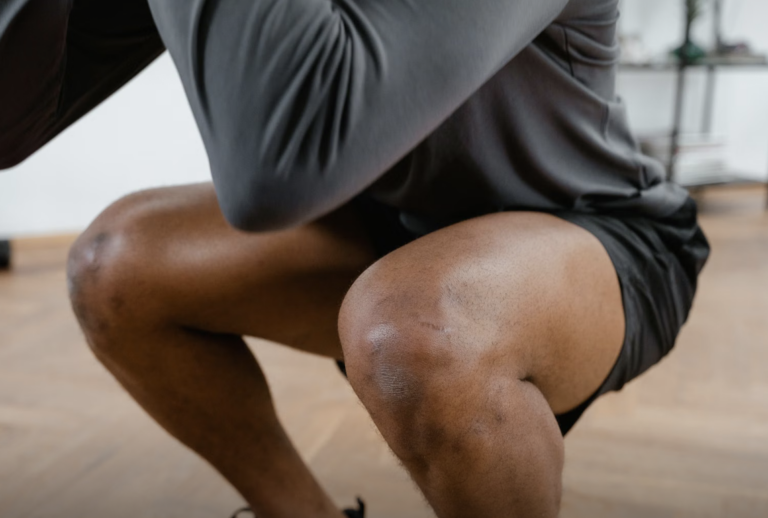
Knee pain during squats is one of the most common reasons people end up in a physiotherapy clinic after starting a strength programme. It can show up as a sharp pinch at the bottom of the movement, a dull ache around the kneecap the next day, or a feeling that the knee is not quite tracking where it should. The instinct is often to blame the knee itself, but the knee is usually the messenger, not the source.
A squat is a whole-body movement, and the knee sits in the middle of a chain that runs from the foot up through the ankle, hip, and trunk. When something further up or down that chain is not working well, the knee often ends up absorbing the consequences.
What does a physiotherapist actually look at?
Rather than staring at the knee in isolation, a proper squat assessment covers several areas.
- Ankle mobility, since limited dorsiflexion often forces the knees to cave inward or the heels to lift to compensate
- Hip mobility and strength, particularly the glutes, which control how well the knee tracks over the foot during the descent
- Foot position and weight distribution, since collapsing arches or uneven weight through the foot change how load travels up the leg
- Depth and control, watching whether the lower back rounds or the knees drift inward as the squat gets deeper
- Bar or load position, for gym-goers doing back squats or front squats, since this changes where the trunk needs to lean and how the knees are loaded
Two of the most common findings are knee valgus, where the knees drift inward during the descent, usually linked to weak hip external rotators and glutes, and limited ankle mobility, which restricts how far the shin can travel forward and forces compensation elsewhere, often through excessive forward lean or an early heel lift.
What kinds of knee pain does poor squat mechanics cause?
Patellofemoral pain, an ache around or under the kneecap, is the most frequent complaint, usually from the kneecap tracking poorly due to hip or ankle limitations. Patellar tendinopathy, pain just below the kneecap, tends to show up with higher training volumes, particularly in people doing frequent jump squats or high-rep squatting. Meniscus irritation is less common but can occur with poor rotational control under heavy load, particularly during a fast, uncontrolled descent.
How is this treated?
- Ankle mobility work, which often has a surprisingly large effect on how the knee behaves during a squat
- Glute and hip strengthening, to improve control of knee position throughout the movement
- Squat technique coaching, adjusting stance width, foot angle, and depth to suit the individual’s mobility and proportions rather than a one-size-fits-all template
- Progressive loading, since the knee joint and surrounding tendons adapt and get stronger with appropriately dosed load, not by avoiding squatting altogether
- Manual therapy where joint or soft tissue stiffness is limiting the movement pattern
Most people notice a real difference in how their knee feels within a few weeks of addressing the underlying mobility and strength issues, though building full confidence back into heavy squatting takes a structured, gradual progression.
Do I need to stop squatting?
Rarely completely. Squats can usually be modified, reduced depth, lighter load, a different stance, or a box squat variation, while the underlying issue is addressed, rather than removed from training altogether. Avoiding squats entirely often makes the knee less resilient over time, not more.
Frequently asked questions
Is it bad if my knees go past my toes when squatting?
Not inherently. Some forward knee travel is normal and depends on your proportions and ankle mobility, though excessive uncontrolled movement combined with pain is worth assessing.
Why do my knees cave in when I squat deep?
This is usually linked to weak hip external rotators and glutes that are not controlling the thigh well enough as fatigue or depth increases.
Should I stop squatting below parallel?
Not necessarily, deep squatting itself is not harmful for most people, but depth should match your current mobility and strength rather than being forced.
Can better shoes help my squat knee pain?
Sometimes. Flat, stable shoes or a small heel lift can help people with limited ankle mobility achieve better squat positions, though it does not replace addressing the mobility itself.
How long does it take to fix squat-related knee pain?
Many people notice improvement within three to six weeks of targeted mobility and strength work, though it depends on how long the pain had been present.
If your knees complain every time you squat, it is worth having your technique and mobility properly assessed rather than just avoiding the movement. A physiotherapist in Dubai can pinpoint what is driving the pain and get your squat back on track. You can book a session here.
Want to live longer, and feel better while doing it?
Twice a week I share practical, physiotherapy-backed insights on longevity, movement and healthspan — no fads, just what actually works.

Marcos Jusdado is a physiotherapist and osteopath at Kinesis Clinic, Vida Emirates Hills, in the heart of Dubai. With 9 years of experience and over 12,000 sessions, he specialises in sport physiotherapy, functional neurology (P-DTR), vestibular rehabilitation and chronic pain, working with everyone from busy professionals to competitive athletes. His approach focuses on finding the root cause of pain rather than just treating the symptoms, helping his patient to achieve long-lasting results.