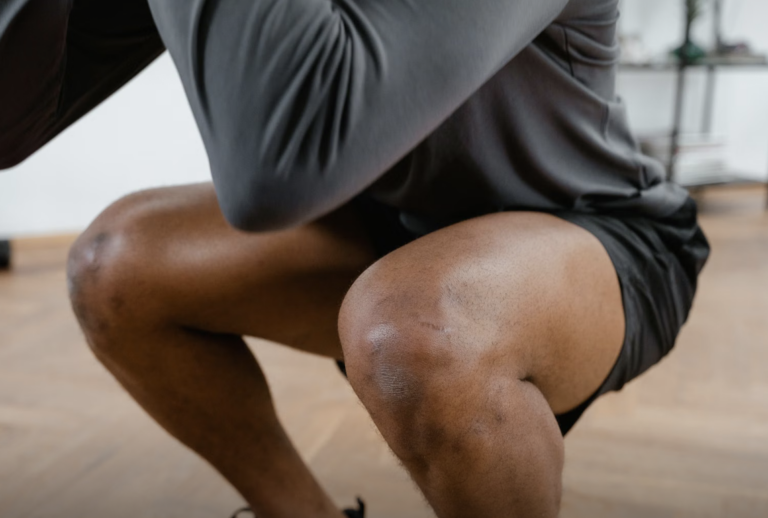
Watch a padel point for more than a few seconds and it becomes obvious how much the knees are doing. A lunge forward to reach a drop shot, a sharp pivot to cover the middle, a sudden stop to avoid the glass, then straight back the other way for the next ball. It’s constant, unpredictable, and repeated dozens of times a match, which is exactly the kind of loading pattern that tends to catch up with the knee over a season of regular play.
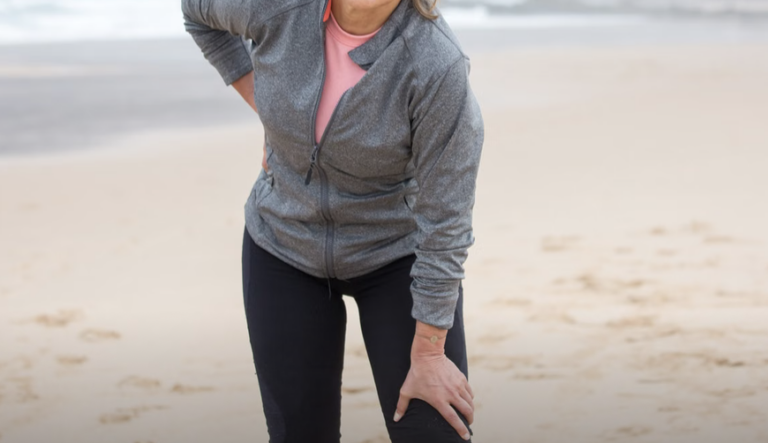
Knee pain in padel players ranges from a mild ache after a long session to a sharper pain that makes lunging or pivoting genuinely uncomfortable. It’s rarely from one dramatic moment, most cases build gradually as the joint absorbs more load than it’s been conditioned to handle.
Why does padel stress the knee the way it does?
Padel combines quick deceleration, sharp direction changes and deep lunges, all performed on a hard court surface with relatively little give. Every time a player suddenly stops to change direction, the knee has to absorb and control that force almost instantly, and the muscles around the joint, particularly the quadriceps and the muscles supporting the hip, need to be strong and coordinated enough to share that load. When they’re not, more of the strain lands directly on the knee’s joint structures.
- Repeated deep lunges reaching for low or wide balls
- Sudden deceleration and direction changes near the glass
- Playing on hard indoor or outdoor court surfaces with little shock absorption
- Worn or unsupportive court shoes that don’t manage lateral movement well
- Weakness in the hips or quadriceps, meaning the knee compensates for control it doesn’t have upstream
- Jumping quickly into frequent play, two or three sessions a week, without the leg muscles adapting first
What are the common patterns of knee pain in padel players?
Pain around or under the kneecap, often described as an ache that’s worse going down stairs or after sitting for a while, is one of the most frequent presentations and usually relates to how the kneecap tracks during bending and straightening. Pain on the inner or outer side of the knee can point toward strain of the supporting ligaments or the tendons crossing the joint, often linked to repeated lateral lunging. Less commonly, a specific twisting incident during a match can cause a more significant injury to the meniscus or a ligament, which tends to come with swelling and a clearer moment when it happened.
How is padel-related knee pain treated?
For the gradual, overuse-type knee pain that makes up most padel cases, treatment centres on rebuilding strength and control in the hip and thigh muscles that support the knee, alongside addressing any mobility restrictions that are changing how the joint moves. Taping or bracing can help temporarily during flare-ups, but the lasting fix usually comes from a structured strengthening programme, not from resting completely and hoping it settles on its own.
Where a specific injury has occurred, with swelling, locking or real instability, a proper assessment is important early on to understand exactly what structure is involved and whether imaging is needed, since a torn ligament or meniscus is managed quite differently from an overuse strain.
Can knee pain be prevented in padel?
A lot of it can. Building strength in the hips, quadriceps and calves off court gives the knee more support during the sudden movements padel demands. Good court shoes with proper lateral support matter more than players often think, and progressing playing frequency gradually rather than suddenly jumping from once a week to three or four sessions gives the joint time to adapt.
Frequently asked questions
Why does my knee hurt more after lunging in padel?
Deep lunges load the front of the knee significantly, and if the surrounding muscles aren’t strong enough to share that load, the joint itself takes more strain than it should.
Is knee pain from padel a sign of arthritis?
Not usually, especially in younger or middle-aged players. Most padel knee pain relates to overload and muscle control rather than joint degeneration, though a proper assessment can confirm this.
Should I ice my knee after playing?
Ice can help manage discomfort after a session, but it doesn’t address the underlying cause, so it works best alongside a proper strengthening plan rather than instead of one.
Do I need better shoes to protect my knees in padel?
Court-specific shoes with good lateral support genuinely help manage the sideways loading padel creates, and worn-out running shoes are a common overlooked factor.
How long does padel knee pain take to improve?
Mild cases often improve within three to five weeks with the right strengthening programme, while more significant injuries can take considerably longer.
If your knee has started complaining every time you lunge for a ball, it’s worth getting the real cause identified rather than just resting and hoping. A physiotherapist offering sports physiotherapy in DIFC can assess your knee properly and build a plan that keeps you moving confidently on court. You can book a session here.
Want to live longer, and feel better while doing it?
Twice a week I share practical, physiotherapy-backed insights on longevity, movement and healthspan — no fads, just what actually works.

Marcos Jusdado is a physiotherapist and osteopath at Kinesis Clinic, Vida Emirates Hills, in the heart of Dubai. With 9 years of experience and over 12,000 sessions, he specialises in sport physiotherapy, functional neurology (P-DTR), vestibular rehabilitation and chronic pain, working with everyone from busy professionals to competitive athletes. His approach focuses on finding the root cause of pain rather than just treating the symptoms, helping his patient to achieve long-lasting results.