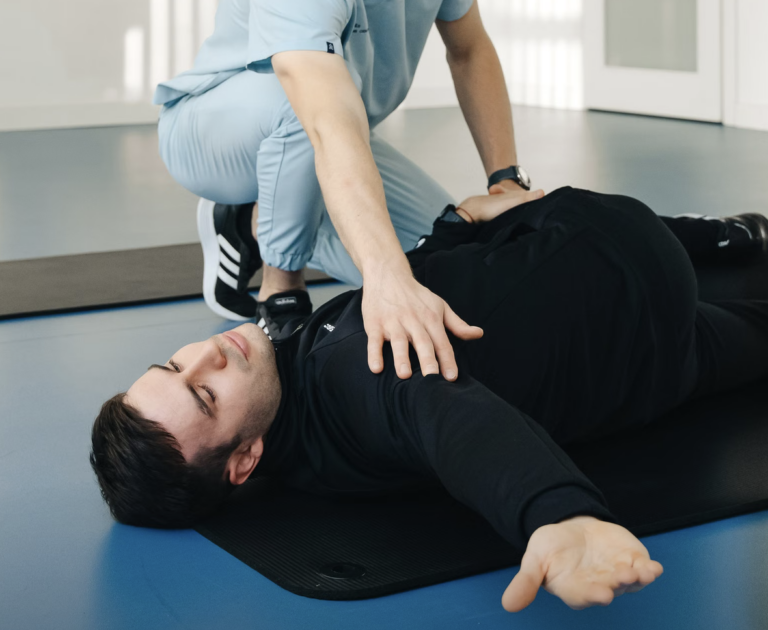

It’s a particular kind of frustrating. The shoulder is manageable during the day, maybe a bit stiff or achy, but liveable. Then you lie down, roll onto that side, or even just settle into bed, and the pain wakes you up. Some people end up propped on pillows or sleeping in a chair just to get a few hours of rest. Night-time shoulder pain is one of the most common complaints seen in physiotherapy clinics, and it almost always has an identifiable, treatable cause.
Why does shoulder pain get worse at night specifically?
Several things conspire together after dark. Lying down removes the support that gravity and upright posture normally give the shoulder, so the joint and surrounding tissues have to be held in position differently. Direct pressure on the shoulder when lying on the affected side compresses inflamed structures like the rotator cuff tendons or the bursa. And without the distraction of daytime activity, the nervous system tends to pick up on pain signals more easily, which is why aches that were background noise during the day can feel much sharper once you’re trying to sleep.
What conditions typically cause night pain?
- Rotator cuff irritation or tears, where the tendons are compressed by side-lying pressure
- Shoulder impingement, which flares with certain arm positions used unconsciously in sleep
- Frozen shoulder, a condition where night pain is often the very first and most severe symptom
- Bursitis, where the fluid-filled cushion around the joint becomes inflamed and sensitive to pressure
- Referred pain from the neck, which can mimic shoulder pain and often worsens with certain pillow positions
How can I tell what’s causing mine?
The pattern gives useful clues. Pain that’s sharp specifically when lying directly on the shoulder, but eases when you roll onto your back or the other side, points more toward rotator cuff or bursa irritation. Pain and stiffness that’s severe in almost every position, combined with a shoulder that’s becoming genuinely hard to move in all directions, particularly reaching behind the back, is a strong sign of frozen shoulder. Pain that changes with neck position, or comes with pins and needles down the arm, often traces back to the neck rather than the shoulder joint itself. A proper assessment sorts out which of these is actually going on, since the treatment differs for each.
What can help in the short term?
- Sleeping on your back with a small pillow or rolled towel supporting the affected arm
- If side-sleeping on the unaffected side, hugging a pillow to keep the sore arm supported and slightly forward rather than letting it fall across the body
- Avoiding sleeping directly on the painful shoulder altogether until it’s settled down
- A pillow under the head that keeps the neck in a neutral position, particularly if the neck may be contributing
These adjustments buy some relief, but they’re a workaround, not a fix. The actual solution depends on treating whatever is driving the irritation in the first place.
How is it actually treated?
Once the specific cause is identified, treatment typically combines manual therapy to reduce irritation and stiffness with a graded exercise programme to rebuild strength and control in the shoulder. For frozen shoulder, treatment focuses more on gently restoring range of movement over time, since forcing strength work too early can aggravate it. A physiotherapist in DIFC will often also look at how the shoulder is being used, and not used, during the day, since a shoulder that’s stiff or weak from long hours at a desk is more likely to react badly to being loaded awkwardly overnight.
Frequently asked questions
Why does my shoulder only hurt at night and not during the day?
Lying down changes the pressure and position on the shoulder, and the absence of daytime distraction makes pain signals more noticeable, which is why symptoms that are mild during the day can feel much worse once you’re trying to sleep.
Is night pain a sign of something serious?
Not usually, most causes are mechanical and treatable, but persistent night pain that doesn’t improve with position changes and rest is worth having assessed properly rather than ignored.
Will changing my pillow fix it?
It can reduce the irritation enough to sleep better, but it doesn’t address the underlying cause, so symptoms are likely to return once you stop being careful with positioning.
How long until night pain improves with treatment?
Many people notice better sleep within two to four weeks of starting the right treatment, though full resolution depends on what’s actually causing it.
Could it be coming from my neck rather than my shoulder?
Yes, this is common. Neck-related shoulder pain often changes with head and neck position and can include tingling down the arm, which a physiotherapist can distinguish from a true shoulder problem.
If your shoulder is costing you sleep night after night, that’s worth sorting out properly rather than adapting around it indefinitely. You can book a session here.
Want to live longer, and feel better while doing it?
Twice a week I share practical, physiotherapy-backed insights on longevity, movement and healthspan — no fads, just what actually works.

Marcos Jusdado is a physiotherapist and osteopath at Kinesis Clinic, Vida Emirates Hills, in the heart of Dubai. With 9 years of experience and over 12,000 sessions, he specialises in sport physiotherapy, functional neurology (P-DTR), vestibular rehabilitation and chronic pain, working with everyone from busy professionals to competitive athletes. His approach focuses on finding the root cause of pain rather than just treating the symptoms, helping his patient to achieve long-lasting results.